
Church Communications During Stewardship Season: 5 Stories to Tell First
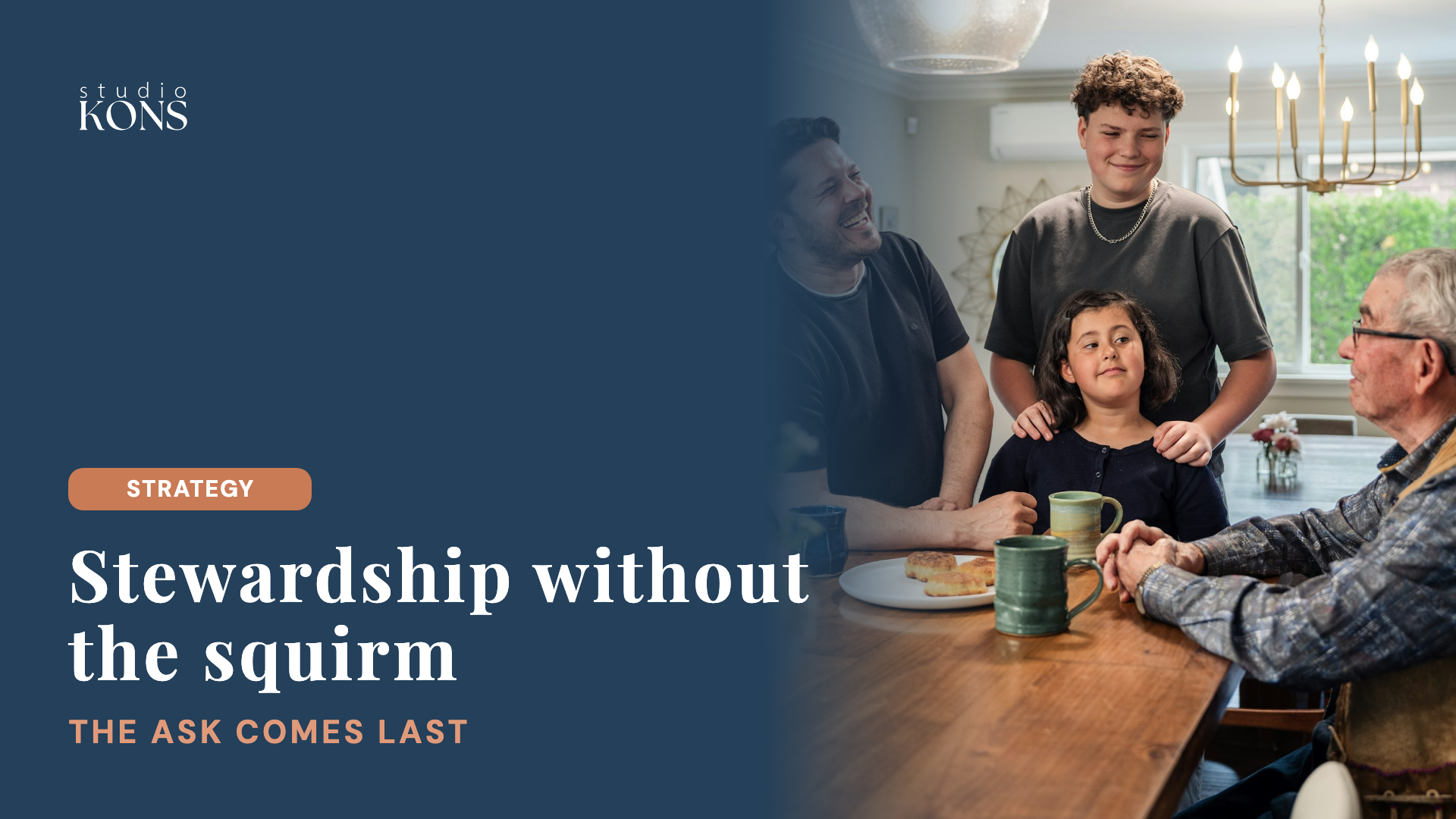
Stewardship season is uncomfortable for basically everyone. Here's how to make it feel like the ministry it actually is: a storytelling campaign with the ask at the very end, and five specific stories that move a pledge card.
Every October, churches across the country hold their breath, design a thermometer graphic, and hope the pledge cards come back.
I want to talk about the part that happens before the thermometer, because it's the part almost nobody talks about... and it's the whole job. I know, I know. If you tensed up a little just now, you're in very good company. Asking people for money is uncomfortable for basically everyone, and asking for money in a church context has this whole extra layer to it: we absolutely can't, under any circumstances, sound like we're pressuring anybody.
Church communications during stewardship season can feel like ministry again. It starts when you treat the whole season as a storytelling campaign and save the ask for the very end. Let me walk you through how.
Why Stewardship Season Feels So Uncomfortable
Churches tend to go one of two ways during stewardship season. Either they produce the most generic, anodyne, please-give-we're-grateful content imaginable (the stuff that technically says something and actually says nothing), or they go radio silent, mail the pledge card, and cross their fingers.
I say this with so much love: both of those are a mistake. The generic content says nothing specific enough to land, and the silent version misses the whole opportunity to tell the story of what your congregation makes possible together.
The good news is there's a much better way, and you get to sound exactly like yourselves while you do it.
A Stewardship Campaign Is a Storytelling Campaign
Here's the sentence I'd love for you to hold onto for the rest of this piece:
A stewardship campaign is a storytelling campaign. The ask is the last thing, and the story is the whole job.
Here's what I see in most churches: they treat stewardship like a single event. Pledge Sunday is October 20th (or whenever yours is), so they send one letter, one email, maybe post something, and then wait and see who sends back a card. And the content of basically all of those communications is some version of your generosity matters, please continue to be generous.
Which, sure, is so true! It just doesn't move anyone. It doesn't move the person who's been wondering whether their pledge actually does anything, or the person who's newer and still figuring out if this congregation is where they want to invest their time and their money.
The story is what moves people, and specifically the story of what their giving actually makes possible. Most churches skip it entirely because nobody ever told them that was the job. So let's talk about what the job looks like.
Five Stories to Tell in Your Stewardship Campaign
Before you write a single piece of stewardship content, before you open Canva, before you draft a single email, sit down and write out five things your congregation does that the budget makes possible: actual things, specific things, things with texture and detail and hopefully a face or a name attached.
Here are the five I'd start with, in the kind of church I'm always thinking about when I make this show.
Story one: small circle suppers. Every church has a version of this, right? Small groups gathering in each other's homes or at the church for conversation, for the kind of real human connection that's hard to find right now when everyone is busy and tired and overcommitted. And that gathering happens because of infrastructure: someone coordinating it, a little budget behind it, pastoral staff who champion it. When you tell that story, you're asking people to give to the dinner where they made a real friend. That's such a more powerful ask than "give to our programming budget."
Story two: your community meal program. If your church feeds neighbors who are struggling, picture the actual cost of that for a second. The food, the volunteers who need coordinating, the kitchen that has to function, the staff time that keeps it consistent (and consistency is the whole thing here). Most churches tell this story with "we serve our community" on a poster. Tell the actual story: the table that fills up at the same time every week, the person who's been coming for two years, the regularity of showing up. Showing up consistently is such a powerful form of love, and it costs something, and your congregation's giving is what makes it possible.
When you use photos here, please be thoughtful. These are people in vulnerable situations, and they deserve dignity in your communications as much as they do in person. That means no identifiable faces without explicit permission, so think hands around a coffee cup, a full table seen from behind, a volunteer laughing with someone whose face is turned away. You can tell a powerful visual story and still protect people's privacy, and doing that protection well is part of the story too.
Story three: the professional musicians in your choir. Not every church has them. Mine does! So I'm going to say the quiet part out loud: yes, some choir members are paid professionals, and yes, some congregants occasionally wonder if that's a lot. Here's my answer, and you can absolutely use it in your campaign: world-class worship is a theological statement. It says we believe this gathering matters. It says what happens in this room on Sunday morning is worth doing excellently. Your music budget is often the reason a first-time visitor walks in and feels something they weren't expecting, and the reason someone who hasn't been to church in twenty years comes back for the Christmas concert, sits in the back row, and maybe gets a little emotional. That's ministry, and we want to say it loudly.
Story four: your children's ministry. Two things here. First, children's ministry is one of the main reasons young families come and stay. If a parent drops their four-year-old off on Sunday morning and that child comes back from church school having had a great experience, that family is coming back. Full stop. And that experience runs on a budget: curriculum, supplies, paid staff or stipended volunteers who show up every single week for the smallest members of your congregation.
Second, photos can be tricky here, and we want to get this right. No identifiable faces of children without parental consent on file. Work with photos from behind, group shots where faces aren't visible, or photos where you have documented permission from the family. This is a trust issue with the exact families you're trying to reach. The story of children's ministry, though? Full permission to tell it warmly and specifically: the curriculum, the annual events, the moment a kid asked a question so good it stopped a volunteer cold (the kids' questions are my favorite). Those stories, told well, are what make a parent reach for the pledge card.
Story five: your staff. I have to be honest, I'm biased on this one. Your staff team is the connective tissue of everything else on this list. It's the clergy who show up when someone calls at 11pm because their parent just died. It's the office administrator who somehow knows where every single piece of paper in that building is and who to call about literally anything, and who is (if we're being real) the actual reason the church functions day to day. It's the children's ministry coordinator who texts the volunteers every Saturday because otherwise half of them forget. It's the music director who has poured themselves into Sunday morning week after week. In the most immediate, practical sense, your staff IS the church. So get a short quote from a staff member about why they do this work, post a photo, and tell your congregation who these people actually are and what they do on behalf of everyone else. It lands every time.
The full episode goes deeper on all five of these, plus why a stewardship campaign has the exact same shape as event promotion. Listen below.
The Vision Piece Almost Every Campaign Skips
Once you have your five stories, there's one more piece I'd love for you to add, and it might be new to you entirely: the vision.
Most stewardship campaigns frame the ask as maintenance. Costs have gone up. We need to cover our expenses. Please give the same or even a little bit more. And oh my goodness, I get it. Costs really have gone up (we're preaching to the choir here). Framing giving as survival math, though, is one of the least inspiring things we can do.
So what if the vision piece was about possibility? What would an increase in generosity make possible? What's the ministry you've been dreaming about? What program would you expand? What might your community meal grow into with more resources behind it?
You're allowed to say that out loud. You're allowed to paint that picture of vision and imagination. It means you're inviting your congregation into something being built, and that's a much better and more exciting story to be part of.
How to Pace Church Communications During Stewardship Season
You don't have to write all five stories in one piece of content. This is a campaign, so you have weeks, and that's the great news! Each story is a post, an email, a moment in the bulletin. You build the case over time, story by story, so that by the time pledge Sunday arrives, your congregation is being asked to keep funding five things they already care about and have just been reminded how much they love.
The pacing follows the same phases I teach for event promotion in Event Ease, because a campaign has the exact same shape. Get clear first: figure out your stories, get your photos, write your core narrative before anything goes public. Then invite: introduce the campaign and tell the first story. Then build energy, which is the phase most churches skip, where you keep telling stories, share the vision, and give people reasons to care before you ever ask for anything. Then the final push: pledge Sunday and the ask, with all of that context built up behind it. And then celebrate, because acknowledging what your congregation does together is part of the ministry.
Frequently Asked Questions About Church Communications During Stewardship Season
How should a church communicate during stewardship season?
Treat the whole season as a storytelling campaign and save the ask for the end. Spread five specific stories about what the budget makes possible across several weeks of email, social media and bulletin content. Church communications during stewardship season land best when the ask comes after weeks of storytelling.
What stories should churches tell during a stewardship campaign?
Five real ministry stories that show what your congregation's giving already makes possible. For instance: small circle suppers or fellowship gatherings, your community meal program, your music ministry, your children's ministry and your staff. Make each one specific and human, with a face or a name attached where you have permission.
How do we photograph children and vulnerable neighbors for stewardship materials?
For children, no identifiable faces without parental consent on file. Use photos from behind, group shots where faces aren't visible, or photos where you have documented permission. Hold the same standard for neighbors at meal programs and outreach ministries: hands, tables seen from behind, moments with faces turned away.
Should our stewardship campaign include a vision piece?
Yes! Most campaigns frame the ask as covering costs. A vision piece paints a picture of what an increase in generosity would make possible: the ministry you've been dreaming about, the program you'd expand. It invites your congregation into something being built.
My question for you: what are the five stories your church could tell right now, if you sat down and wrote them out this afternoon?
If you'd like help building that arc, Event Ease takes your timeline and your channels and gives you a custom plan, phase by phase, so you're never staring at a blank content calendar in October. Find it at studiokons.com/eventease.